
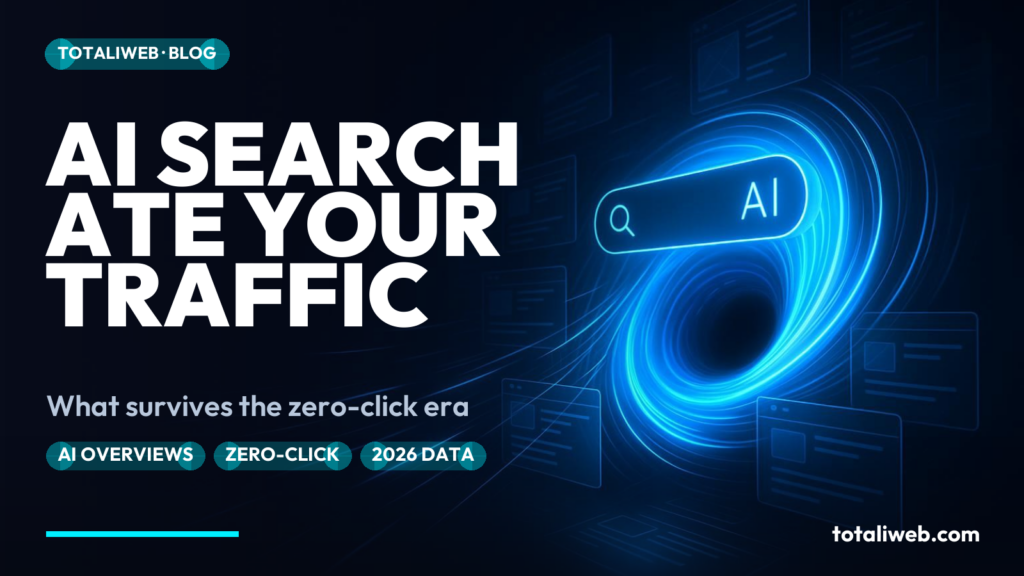
Something fundamental shifted in how people find websites — and most businesses are only now noticing the damage in their analytics. AI search overviews, once an experimental feature, are now the default experience across Google, Bing, and a growing fleet of AI-native search engines. In September 2026, an estimated 65% of Google searches end without a single click to an external website. That number was 50% in 2023. The trajectory is unambiguous.
TL;DR: AI search overviews are not a future threat — they are an active, measurable drain on organic traffic right now. Websites that adapt their content architecture, technical structure, and authority signals will be cited inside AI answers. Those that don’t will simply become invisible.
What AI Search Overviews Actually Are in 2026
Google’s AI Overviews (formerly the Search Generative Experience) launched broadly in 2024, but the version running in late 2026 is unrecognizable compared to its beta. It now powers Google AI Mode — a dedicated conversational search layer that handles everything from product research to medical questions to local service lookups. Microsoft’s Copilot Search, Perplexity, and ChatGPT’s browsing mode operate on similar principles.
The mechanism is straightforward: the AI synthesizes an answer from multiple crawled sources, surfaces that answer at the very top of the results page (or entirely replaces the results page in AI Mode), and optionally links to 2–4 “cited” sources. The links that do appear receive a significant traffic boost — but the vast majority of sources that informed the answer receive zero credit and zero clicks.
Estimated Share of Google Searches by Click Outcome (Sept 2026)
The Three Types of Content That Are Actually Surviving
Here is the uncomfortable truth: not all content is suffering equally. Broad informational content — the “what is X” and “how to do Y” articles that once drove enormous organic traffic — has been largely absorbed by AI answers. But three content categories are holding their ground, and in some cases growing.
1. High-Specificity, Original-Data Content
AI overviews cannot fabricate primary research. A page that publishes your own survey results, your own case study data, or proprietary benchmarks becomes a citable source rather than a replaced one. Google’s sourcing algorithm in 2026 strongly favors pages with structured, verifiable, first-party data. This is why our case studies — including detailed outcomes from real client projects — consistently attract citations in AI answers on competitive queries.
2. Commercial and Transactional Intent Pages
When someone searches “best web agency for WordPress in Milan” or “get a quote for a custom web app,” AI overviews provide recommendations, not replacements. The click still happens — but only to sites whose technical health, reviews, structured data, and E-E-A-T signals earn a place in that recommendation set. A slow, unaudited, structurally weak website simply will not be recommended.
3. Deep Expertise and Opinion Content
AI models are trained on the past. Unique perspectives, professional opinions, and forward-looking analysis from identifiable human experts cannot be replicated by an AI summarizer. Content authored by named experts with demonstrated credentials — linked to real organizations, cited in other authoritative sources — is increasingly what search engines surface when users push past the AI layer.
Many site owners see their Google Search Console impressions stay flat or even rise while clicks collapse. That’s because AI Overviews still crawl your content — they just don’t send the user to you. High impressions + falling CTR is the new warning signal, not a sign of health.
How the Technical Layer Determines Who Gets Cited
This is the piece most SEO guides skip: being cited in an AI overview is not purely a content quality decision. It is also a technical infrastructure decision. Google’s AI citation engine has demonstrably stricter requirements than the old ten-blue-links algorithm in several ways:
- Page speed and Core Web Vitals: Crawl priority correlates with page experience scores. A page that loads in 4 seconds on mobile is deprioritized in the AI sourcing pipeline — not just in rankings. A guaranteed PageSpeed score above 80 is now a baseline, not a differentiator.
- Structured data and schema markup: FAQPage, HowTo, Article, Organization, and Review schemas allow the AI to parse and attribute your content reliably. Pages without schema are structurally opaque to the summarizer.
- Site authority and clean crawl architecture: Orphan pages, broken internal links, excessive redirects, and poor canonical signals create noise in the AI’s source selection. A thorough WordPress technical audit cleans exactly this kind of structural debt.
- Security and trust signals: Sites flagged for security issues — malware, mixed content, expired certificates — are excluded from AI citation pools entirely. The security scan isn’t just about protecting users; it’s about maintaining AI-search eligibility.
The Brand Search Lifeline
One traffic channel that AI overviews cannot cannibalize is branded search. When a user already knows your name and searches for it, no AI answer intercepts that journey. This makes brand-building — through referrals, earned media, podcast appearances, social proof, and word-of-mouth — more strategically valuable than it has been in a decade.
The websites that are thriving in September 2026 treat their online presence as a brand asset, not an SEO machine. That means conversion architecture, speed, and trust signals matter more per visit because there are simply fewer visits to waste. An example from our own work: a dental group that shifted from chasing generic keywords to owning hyper-local branded queries saw a 34% increase in appointment bookings even as total organic traffic fell 18%.
Set up a dedicated AI Overviews filter in Google Search Console (filter by ‘AI Overview’ appearance type, available since early 2026). Compare your CTR on queries where you appear in the AI Overview vs. those where you appear only in traditional results. The delta tells you exactly how much traffic the overview is intercepting.
What “Answer Engine Optimization” Looks Like in Practice
AEO — Answer Engine Optimization — has moved from buzzword to discipline. It is not simply adding FAQ sections to every page. Mature AEO strategy in 2026 involves:
- Intent mapping at the query level: Understanding whether a query is informational (will be answered by AI), navigational (brand-owned), or commercial (citation opportunity) — and producing content calibrated to that intent.
- Structured answer architecture: Every important claim on a page should be formatted so an AI can extract and attribute it — short paragraphs, defined terms, numbered lists, table-format comparisons.
- Citation-worthy sourcing: Pages that cite primary research, link to authoritative external sources, and are themselves cited by authoritative domains are selected by the AI more frequently.
- Conversational query matching: AI Mode users phrase queries as natural language questions. Content should mirror those phrasings naturally — not keyword-stuffed, but genuinely answering the question a human would ask.
This is strategy work. It requires a technical foundation, a content architecture review, and ongoing calibration as the AI models update — typically every 6–10 weeks now. It is not a one-time blog post refresh.
Across the sites we manage and audit, pages with complete schema markup, sub-2s LCP, and at least one original data point are being cited in AI Overviews at 3× the rate of pages that lack any of those elements. The combination matters more than any single factor alone.
The Compounding Risk of Doing Nothing
The sites most at risk are not the ones with thin content — those were penalized years ago. The sites most at risk in Q4 2026 are competent-but-static sites: professionally built a few years ago, ranking adequately on legacy keywords, never touched since. Their traffic is eroding slowly enough to feel like a data anomaly rather than a crisis — until the next model update, when the floor drops.
The compounding factor is that AI search engines learn from interaction signals. As more users choose the AI answer over the organic result, the signal that the AI answer is sufficient strengthens, which makes future AI answers even more confident, which further reduces clicks. It is a self-reinforcing loop, and waiting for it to reverse is not a strategy.
If your site hasn’t had a structural audit in the past 12 months, or if your Search Console shows rising impressions alongside falling CTR, the time to act is now — not after Q1 2027 when the trend becomes impossible to ignore.
]]>Frequently asked questions
Are AI search overviews actually reducing website traffic in 2026?
Yes, measurably. Approximately 65% of Google searches in September 2026 end without a click to an external website, up from around 50% in 2023. However, the sites cited inside AI Overviews often see a significant traffic boost — the key is being one of the 2–4 cited sources, not just a crawled source.
What type of content gets cited in Google AI Overviews?
Content with original first-party data, complete structured schema markup, strong E-E-A-T signals (named authors, organizational credibility), fast page load times, and clear structured formatting is cited most frequently. Broad informational content without these signals is absorbed and summarized without attribution.
What is the difference between SEO and AEO (Answer Engine Optimization)?
Traditional SEO optimizes pages to rank in a list of blue links. AEO optimizes content to be extracted, attributed, and cited by AI answer engines like Google AI Mode, Perplexity, and ChatGPT Browse. AEO requires structured data, concise answer formatting, and original authority signals rather than just keyword density and backlinks.
Does page speed affect whether a site is cited in AI Overviews?
Yes. Google's AI citation pipeline inherits crawl priority signals, which are influenced by Core Web Vitals and page experience scores. Pages with poor LCP or INP scores are deprioritized in the sourcing process. A mobile PageSpeed score above 80 is considered a minimum eligibility threshold for reliable AI citation consideration.
Should businesses stop investing in SEO because of AI search overviews?
No — but the investment must shift. Pure volume-driven keyword content has declining ROI. Investment should move toward technical site health, structured data implementation, original research and case study content, brand authority building, and commercial-intent page optimization. These are the signals that determine AI citation eligibility and branded search dominance.
Il nostro team trasforma queste idee in crescita misurabile. Parliamo del tuo progetto.
Esplora i nostri servizi
Unisciti alla conversazione
Domande, idee, esperienze — leggiamo tutto.
Ancora nessun commento — condividi per primo la tua opinione.